

It was not in the plans to have a post viewed more than 35,000 times (by far the most ever for this newsletter) in a few days before a long planned two-week vacation. If you are a new paid subscriber because of “The Nonfiction Book Market is Collapsing”, you can read the follow-up “Radical Ideas for Fixing the Nonfiction Book Market” or you might enjoy the other industry-forward posts which are now helpfully organized under the heading “Publishing Econ” on dearheadofmine.substack.com including the one book everyone wanted to publish, the most important books of the year for the entire decade, and questioning whether this lovely industry is feast or famine, and much more.
Dear Head of Mine is now at 4,500 *head explosion* subscribers, I remember giving myself a toast at 500 subscribers, if that gives perspective on my level of joy and surprise and slight befuddlement at this number. Thank you all for supporting the newsletter, for your comments, emails, and encouragement. For the next two weeks there will be reruns of older pieces—Wifi dependent—with some new introductions/commentary sprinkled throughout. Now on to the newsletter!
There are certain familiar situations that come up when you’re a book editor. When you’re at a non-book person dinner party (for once) or a writing conference where the authors are green, for example. Inevitably, at one point, someone will profess their desire to write a novel—in the latter case this is implied—and say some version of “they are just waiting to find the right, great idea.” Many people feel they are just one light bulb moment away from becoming the next Stephen King. The thing is, the more you read hundreds of books and manuscripts, the more this old saw about exceptional concepts fueling the creativity of excellent writers feels increasingly less true.
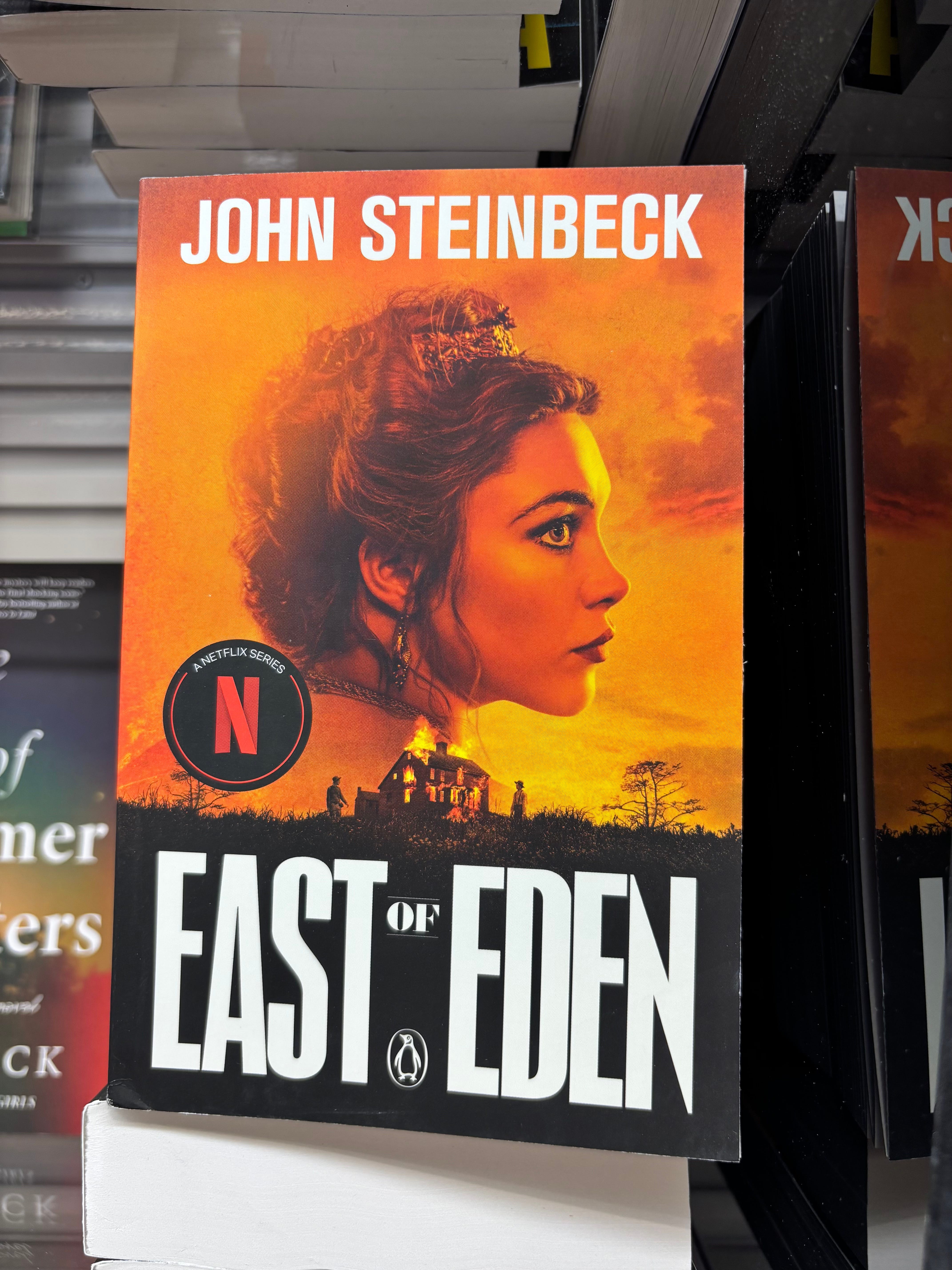
There is an enormous place in the culture for repeating and iterating the same story over and over again. Having just lived through a golden age of IP and sequels—golden as in profitable, not as in gold-standard, perhaps—this should be obvious. But even in a non-commercial sense a lot of the best novels are borrowing from an established tradition. Emily Wilson retranslated The Odyssey, Christopher Nolan remade it as a film, and storytellers have been reinterpreting the hero’s journey uninterrupted for about several thousand years prior. Think back to the classics—many of them don’t have an otherworldly, genius level, original concepts. East of Eden is about different kinds of people settling out west. The Haunting of Hill House is a haunted house novel. To Kill a Mockingbird is, at its core, a courtroom drama.1 Even the aforementioned Stephen King writes in his memoir On Writing about copying before he ever became a novelist:
I read my way through approximately six tons of comic books, progressed to Tom Swift and Dave Dawson (a heroic World War Il pilot whose various planes were always prop-clawing for altitude”), then moved on to Jack London’s bloodcurdling animal tales. At some point I began to write my own stories. Imitation preceded creation; I would copy Combat Casey comics word for word in my Blue Horse tablet, sometimes adding my own descriptions where they seemed appropriate. “They were camped in a big dratty farmhouse room,” I might write; it was another year or two before I discovered that drat and draft were different words.
And a short while later the King weighs in himself on the idea that novel writing starts with a silver bullet, genius idea:
Let’s get one thing clear right now, shall we? There is no Idea Dump, no Story Central, no Island of the Buried Bestsellers; good story ideas seem to come quite literally from nowhere, sailing at you right out of the empty sky: two previously unrelated ideas come together and make something new under the sun. Your job isn’t to find these ideas but to recognize them when they show up.
What makes East of Eden a classic is not the setup but the actual characters and their elaborate, fully realized backstories and collisions. The Haunting of Hill House has all the trappings of a haunted house novel but the language that feels timeless and original whether you compare it to novels in the genre written before or after. To Kill a Mockingbird’s moral message at the heart of the courtroom drama has been dissected and debated ever since. That’s because…
Execution is More Important than Grand Ideas
Now, this seemingly contradicts some past publishing economic advice given here at Dear Head of Mine— which is that the higher concept the bigger the financial opportunity. The appeal of a “great idea” is that you can sell it no matter what. With four months to go we can already crown the “one book” of the year Yesteryear by Caro Claire Burke— a novel that has taken the world by storm largely based on its simply undeniably enticing and timely Trad Wife is Transported to the 1800s premise (see how good that premise is? 7 words total! Completely off the top of the Dear Head). A film that came out earlier this year One Night Only has a now-famous studio pitch that goes “The Purge but for sex.” It’s not particularly surprising that both of these projects with 10/10 elevator pitches have interesting but flawed executions.
Call one-liners like Yesteryear and One Night Only the exceptions. While “high concept” and unique speculative novels are certainly breaking through more than ever, the bread and butter of book publishing is with the writers that can execute simple ideas exceptionally well. Google “family secret novels” and you’ll get popular books as disparate as Malibu Rising, The Last Thing He Told Me, and The Vanishing Half (and about forty dozen others). Look up “marriage thriller” and you have a trove of massively popular options from The Perfect Marriage, The Wife Between Us, Gone Girl, etc., etc. These are just two of the many kinds of stories that never go out of style, it’s no coincidence that they use as a template two of the most emotionally charged, human subjects—family history and marriage.
What Does it Mean to Execute Well?
There’s an enormous amount of originality within straightforward concepts— originality on a macro level is called “ideas” and originality on a micro level is called “execution.” Describing a well-executed book and quoting passages will get tedious quickly. However, other artforms offer plenty of lessons on how a cliché setup or familiar idea can be endlessly reinvented if the artist puts new, exciting scaffolding around it.
On Rob Harvilla’s 60 Songs that Explain the 90s: the 2000s (a favorite of this newsletter2) in his episode examining pop and R&B legend Sade’s By Your Side, he briefly touches on how a simple, mundane sentiment can be transformed by execution. Here is in part the chorus of By Your Side sung repeatedly:
Oh when you’re low
I’ll be there by your side baby
This could not be a more cliché statement, but with a singular voice and intonation, as Harvilla points out, Sade transforms it back into something that is profound. Sade is at times an amazing songwriter but her lyrics are sometimes so boldfacedly cliché and borderline silly on paper. Getting back into their discography3, there are more than a few lines like these. A favorite and perhaps the most egregious, sentences that if you saw in a novel or poetry collection you would think it was the prose of a love-struck teenager:
My love is wider, wider than Victoria Lake
My love is higher, higher than the Empire State
But go listen to Sade deliver these lines and don’t hold back your pure awe that she has the power to pull this off. It’s in the execution.
No Place for Cliché
“While a bad, clunky cliché has a certain effect—in the wrong context it is a sign of laziness—so does a writer struggling over every sentence for several hours to avoid copying the way anyone else has written in the history of language. Belaboring to be original can be equally as sucky to read and have a deleterious effect.”
The defense of cliché at Dear Head of Mine is well known.4 Even on a micro level originality doesn’t mean avoiding cliché entirely. While drafting this essay, this came irritatingly but helpfully came across the Substack feed:
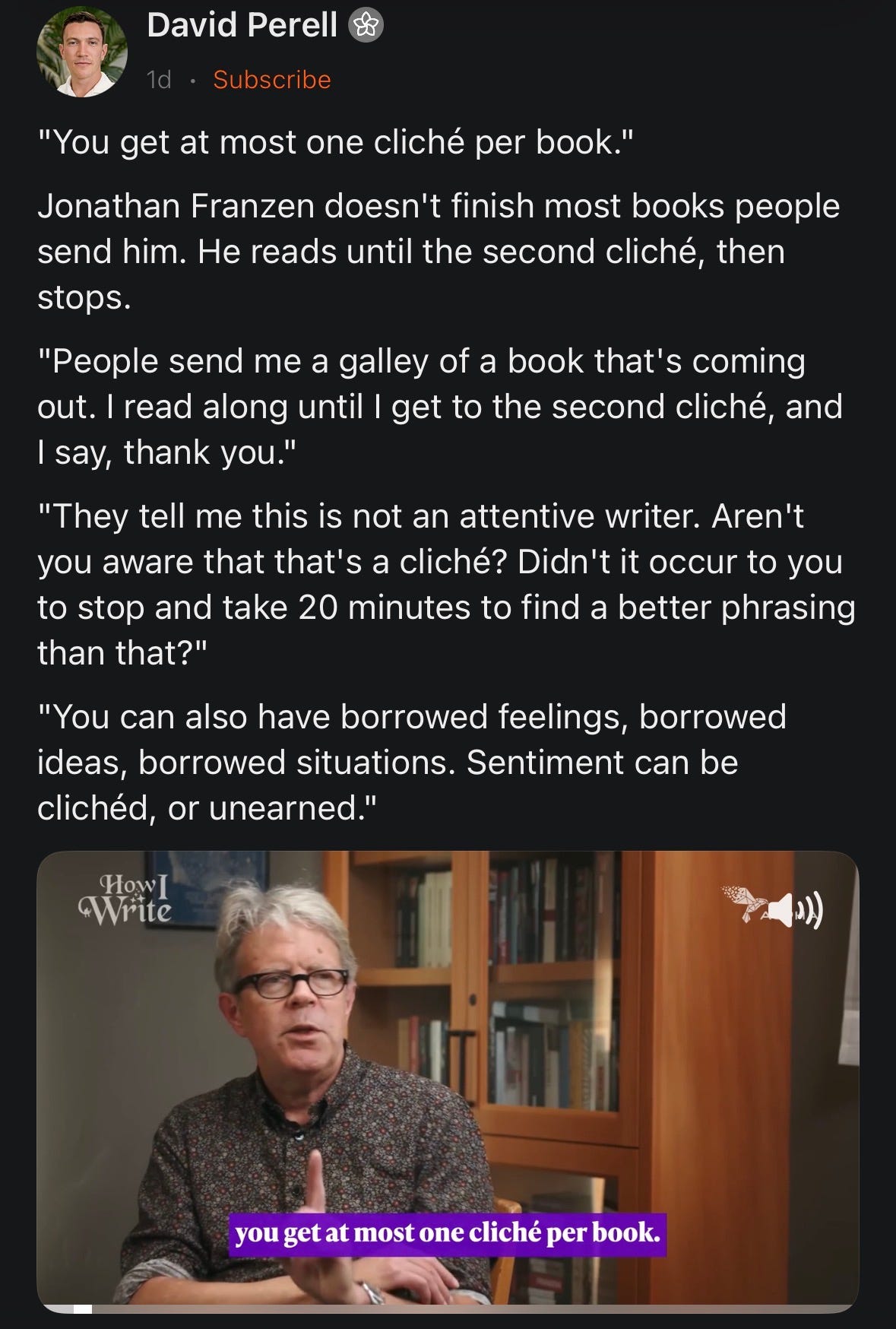
It’s a pretentious stance to take—no offense to Mr. Franzen, although odds are he wouldn’t take offense to this. A purposefully narrow, wears-a-Harvard-crewneck kind of view. A reader can tell 100% of the time when their writer feels the way Franzen does about prose and their novels more generally. While a bad, clunky cliché has a certain effect—in the wrong context it is a sign of laziness—so does a writer struggling over every sentence for several hours to avoid copying the way anyone else has written in the history of language. Belaboring to be original can be equally as sucky to read and have a deleterious effect.
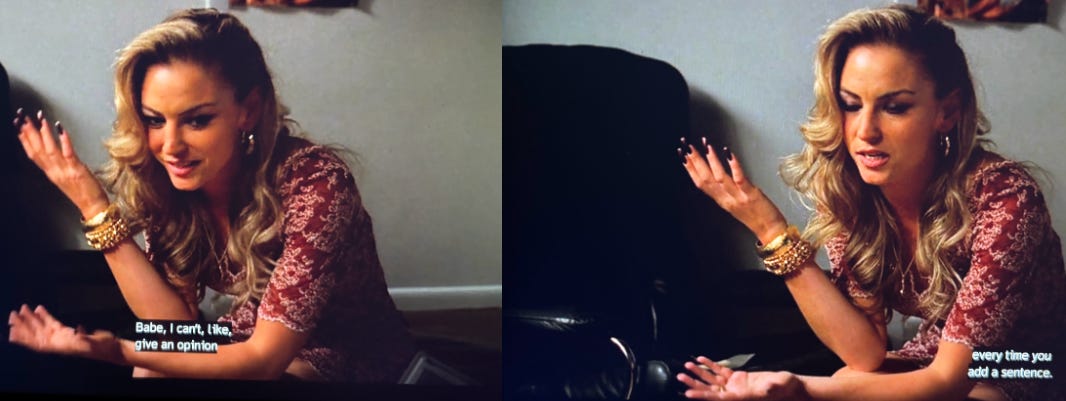
He has a Pulitzer Prize, so we shouldn’t feel bad on picking on Jeffrey Eugenides, whose writing often feels this way. At times in his Pulitzer Prize-winning novel Middlesex it can feel like stacks upon stacks of historical detail5 before we just enter some humble, normal scene. Here is how a typical movement in Middlesex begins:
Three months before I was born, in the aftermath of one of our elaborate Sunday dinners, my grandmother Desdemona Stephanides ordered my brother to get her silkworm box. Chapter Eleven had been heading toward the kitchen for a second helping of rice pudding when she blocked his way. At fifty-seven, with her short, squat figure and intimidating hairnet, my grandmother was perfectly designed for blocking people’s paths. Behind her in the kitchen, the day’s large female contingent had congregated, laughing and whispering. Intrigued, Chapter Eleven leaned sideways to see what was going on, but Desdemona reached out and firmly pinched his cheek. Having regained his attention, she sketched a rectangle in the air and pointed at the ceiling. Then, through her ill-fitting dentures, she said, “Go for yia yia, dolly mou.
This avoids cliché but is the kind of helluva long windup that occasionally makes you thirsty for some simple, familiar language, even if it verges on cliché, lanauge that gets to the point and situates you rather than trying to recreate the whole round world. A cliché is another tool in the toolbox. Clichés can be shallow and simplistic, but they can also tap into the universal. It’s worth reminding yourself that cliches stem from something so often experienced and repeated that it becomes worn. This is exactly why they can work so well, though—they make readers see themselves, their thoughts and experiences, reflected back at them off the page. Executed correctly, thoughtfully, with the right arrangement and voice to deliver a cliché they can work. If you believe that writing is only about originality and not execution: go listen to Sade.
Apologize to longtime readers, I swear I know more than three examples of classic books.
For those of you who commented about podcasts replacing nonfiction, go read this newsletter, “Should Nonfiction Books Just be Podcasts?”!!!
Sade is technically the band but is also the lead singer of the band named Sade, I didn’t know this until like six weeks ago.
At least it should be.
544 pages.
EAST OF EDEN is not based on an original concept. It's Cain and Abel in California.
I keep telling my 18-year-old nephew this, but he doesn’t believe me. (Why would he believe this aunt about writing good books? His aunt is only a bestselling author.)