This is an essay previously published in August 2024, revised and updated with new commentary and data.
There is an old school notion about youth, creativity, and commerce that has been true for about forever. Art and the people who sell it put a heavy premium on youth. Think of Mozart performing at age 5 back in the 1700s. As recently as the early 2000s, this was an equally easy conclusion to draw. The turn of the century saw the meteoritic rise of Britney Spears and *NSYNC, of Hilary Duff and Lindsay Lohan, of Leonardo di Caprio and Josh Hartnett. For a time, it seemed like all of culture would forever favor the hotter and the younger. A quick start seemed paramount to success and money and attention always seemed to gather around new stars.
Novel writing was no different. Attention and resources would be given, disproportionately, to promising young talents. From Jay McInerney and Bret Easton Ellis in the 80s, to David Foster Wallace and Donna Tartt in the 90s, to Zadie Smith and Jonathan Safran Foer in the early 2000s. Young genius has been a tried and true publishing strategy for awhile. Conversely, it seemed older writers were at an unfair disadvantage, that lists about debuts and writers under 35 were ageist.
This perception of the media reality began to be supplanted by the reality of working directly in a creative field. Over the course of my editing career I have watched as none of the young writers seemed to gain traction, and as in other creative professions the young, exciting artists never seemed to really gain or maintain a foothold for big, culturally and commercially important careers (sans Taylor Swift, the exceptions of all exceptions). Whether it is Millennial or Gen Z artists, the stars, the huge successes, just aren’t there. Meanwhile the oldest Millennials, Gen X, and the ever-present Boomers seem to be thriving.
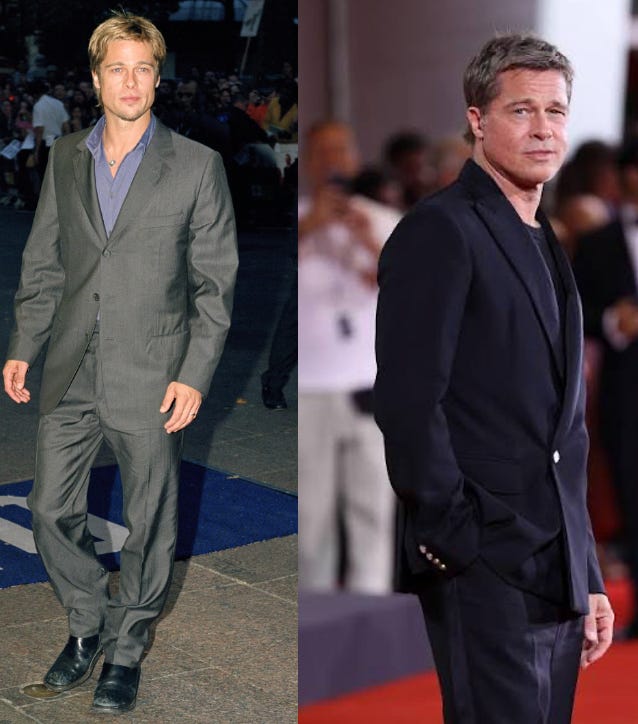
2026: A personal, minor obsession. Celebrities from the early 2000s have somehow got better looking while also aging 25 years, even the extraordinarily good looking ones. Lots of this having no doubt to do with better style—but it’s no wonder they’re sticking around in the culture longer. This is not what 62-year-olds should look like (photo on the right).
Publishing mirrors the rest of society, where older people remain in power in politics, in business, and even at the box office. Obama, viewed as a young president when he first took office, is in fact a Boomer, born in 1961, a year no sitting president has been born after (born in 1964 Kamala Harris would have been the first Boomer/Gen X cusp president). Out of all of the Fortune 500 companies only 40 CEOs are below the age of 50. Of the top-20 actors who are the biggest box office draws, only 4 of the actors are in their 40s (including Bradley Cooper, 49), one is in their 30s (Scarlett Johansson, 39), and one is in their 20s (Tom Holland).
2026: This remains basically true. Although one couple, Tom Holland and Zendaya, are singlehandedly bucking this trend. Timothee Chalamet and Robert Pattinson also are becoming visible, consistent stars. There’s other signs of life that the grip of the boomers is slowly and naturally slipping away when it comes to cultural dominance. Half of CEOs are Baby Boomers but a good many of them are Gen X. Zohran Mamdani is an extremely notable millennial politician. The change of pace of the cultural relevance of each generation has been perhaps at its slowest changeover ever, but it is happening ever so slowly.
In publishing, older authors dominate literature and even grow stronger later in their careers. A few weeks ago we talked about Percival Everett who, 23 novels into his career, finally struck it big. There are many other writers who are prolific, critically adored, and commercially successful in this last decade like Ann Patchett, Barbra Kingsolver, Richard Powers, and Colson Whitehead. This is not to pit the generations against each other. Unlike other realms of art and commence, publishing has never felt like a zero-sum game. These older authors are all writing consistently great books and occasionally transcendent ones. But book publishing is unlike business or politics where there are a finite number of positions to be occupied and unlike movies where there are limited budgets constraining who gets to make what. Older writers can’t hold younger ones back from writing great books even if they wanted to. So why aren’t there younger writers filling these roles? Where are our millennial Zadie Smiths, Ann Patchetts, and Stephen Kings?
2026: In contrast to the above examples of business and Hollywood getting—relatively—younger, this has not happened as much in books, especially on the literary side of the spectrum. Ann Patchett new novel is on pace to be her bestselling book ever. After a 17 year hiatus since The Help Kathryn Stockett came back and penned a multi-month bestseller as if she hadn’t skipped a beat.
An admission, however: this essay may have overstated the problem a bit. One of the issues with literary fiction is that in contrast to the nonfiction market collapsing , fiction on a whole is such a strong market. Because commercial fiction is selling so well, it’s almost impossible for literary books to make it onto the New York Times bestseller list, which is still the gold standard for mainstream accomplishment and visibility in book publishing.
Lost Lambs was a hugely successful and discussed literary debut published this year, but it’s not going to hit The List, despite perhaps selling many more copies than a literary debut from yesteryear (speaking of, Yesteryear, yet another young millennial literary novelist lighting the world on fire). Emma Cline has also developed a nice cadence despite what is said below about young writers not having a high output. Cline’s newest novel that just came out Switzy will probably be a huge success, but none of her three books after her debut novel, The Girls, has hit the New York Times bestseller list.
Why Aren’t Millennials Writing?
A little digging shows perception of “creative industry rewards youth” may not match the current reality for would-be literary titans under the age of 45. Looking back at 10 years of the National Book Foundation’s “5 Under 35” list, from 2011-2021, so that every writer had a least a few years to have a career and so that the hypothetically oldest person would still be under 50 today. The point of this dataset is to look at a list of writers who gained notoriety early on and see what happened with their careers, to see if, in fact, things have changed for the next generations.
Of’ the 55 novelists, nearly half (21) would never go on to publish another book after they won this distinguishing award for being a young and promising writer. An entire generation of talented literary writers are not producing or having writing careers in the way they used to.
2026: Adding the next two years—2022 and 2023—to this data set has things nearly unchanged with 6 of the next 10 winners having penned multiple books, about the same 40% one-and-done watermark.
Of the 34 writers on these lists that did go on to write more than one book, they averaged a book about once every 3.5 years. Why are authors in this generation writing so few books? One reason may come down to economics. A) There is not enough money in books, especially literary books (if there ever was) to support many writers making writing their full-time gig B) As writing and publishing has become more democratized, open to writers that aren’t just at the very upper echelons of society (think Edith Warton, F. Scott Fitzgerald, etc.), more people get a chance to write and publish, but not necessarily make it their life’s vocations (see reason A). It also becomes the chicken or the egg, with there not being many career Millennial and Gen Z authors, publishers are not aggressively investing in the long-term career of younger literary writers, and then those writers justifiably feel like they can’t get enough investment to rationalize writing full time.
2026: This still feels like the case and there’s a much bigger essay to be written on the shifting class dynamics within the book publishing apparatus and the authors being published (another slooooow shift, but it is a slow business).
One of my favorite books of the past couple of years was The Regrets by Amy Bonnaffons. Aptly called “Murakami for the millennial generation,” The Regrets was praised to the hilt, sold modestly, and Bonnaffons hasn’t been seen since. Meanwhile, the 75-year-old Boomer Haruki Murakami is publishing enough books that one is about his t-shirt collection.
2026: Still hoping the incessant mentions of The Regrets will somehow manifest bringing Amy Bonnaffons out of early literary retirement.
Putting economic factors aside, there is something strange going on. Let’s take the writers from the list who did have enough success right out of the gate and continued to write. Authors like Justin Torres whose books were selected for the Times’ Best Books of the 21st Century or Yaa Gyasi whose debut novel has sold almost one million copies—both of these authors have still only written two novels a piece (Gyasi two books in eight years, Torres two books in twelve).
2026: Yaa Gyasi is still six years without a book and hasn’t announced anything else. Justin Torres just had a classic edition published of his debut 2011 novel, but still hasn’t published a new book since his sophomore novel Blackouts, which is kind of a crazy data point in the context of this essay.
Want to know another depressing fact? There is a grand total of one actual official Millennial (unofficial count)on the NYT best books of the 21st century list—Torrey Peters at the age of 45, which is the oldest possible age of a Millennial. Peters has a grand total of two published books. Justin Torres actual misses the technical Millennial cutoff by a year, Ben Lerner by two, and Gabrielle Zevin by three. A big snub in hindsight is that not one Sally Rooney novel made the best of the 21st list—another sign older generations will not let their grip on culture go.
Or, take a closer look at Brit Bennett’s career, which has pretty much gone as perfectly as it could in the modern era. She was awarded the 5 Under 35 designation in 2016 with her debut novel The Mothers, which sold well, was received well, and set her up to have a career. Then she wrote Vanishing Half, which published in 2020 and was a massive step up on all fronts—one of the best-selling books of the year, shortlisted for the Women’s Prize for Fiction, and named a best book of the year by The New York Times. And yet, as of this writing that’s only two adult books in eight years, with no new book on the horizon. So, what has Brit Bennett been doing if not working exclusively on her next novel? The answer is working for American Girl dolls, to create a new character and write two accompanying books for young readers. This is worthwhile work, but it is exemplary of how economic opportunities whether in academia, Hollywood, or even with toy companies suck up the literary talent and attention of the younger generation. Who can blame them? Why do something that is harder (write a novel) and pays less money than do something that is easier and pays more?
2026: As of writing Bennett doesn’t have another writing project announced, but the adaptation of her second novel The Vanishing Half is rumored to be in the works for HBO.
Bennett’s example and many others on these 5 Under 35 lists suggest there is something larger afoot. Writers of a different generations, like musicians, and even movie stars, are finding it harder to maintain cultural and commercial relevance with staying power. Hand in hand with this shrinking relevance is a heavy dose of distraction. Audiences who are distracted and flinty with a million-and-one entertainment option, a distraction that clearly affects the artists themselves. We live in a time where actors are tequila moguls, rappers are actors, and seemingly everyone owns a makeup, clothing, or lifestyle “brand.” Creative careers are run as empires rather than as individuals who are maximizing creative output in the one discipline they are exceptional at. Writers are no different. Take even the most prolific writer in our sample set Akwaeke Emezi who has written an astonishing eight books in just six years. But in this time Akwaeke has also released a music album, written poetry, made films, and executed visual art projects. Even the popular artists who produce these days are multi-hyphenates pulled in a thousand splintering artistic and commercial directions.
2026: Akwaeke published three (!) books in 2025, a novel, a young adult novel, and a work of nonfiction.
Exceptions to the Rule
Who will be the titans of literature for the Millennial and Gen Z generations? It’s hard to say, but the strong counterpoint to this literary pessimism is that commercial writers, primarily fueled by the boom in romance, in all its forms, are also doing quite fine when it comes to prolific efforts and millions of copies sold. Sarah J. Maas, Emily Henry, Colleen Hoover, seem to have no problem pumping out novels the way Danielle Steel, Lee Child, John Grisham did in earlier decades (and still are, as we see older people stick around longer and be successful in every field—Grisham has been in the top 10 of bestselling fiction books every year for something crazy like the last two decades straight).
2026: The strength of younger commercial novelists has accelerated in the intervening two years, the bestseller list is filled with young writers dominating the field of Romantasy, fantasy and science fiction. Many of them are writing a book a year. R.F. Kuang hit the list this week, again (and may be considered a literary writer by many). 36-year-old Rachel Gillig outsold the entirety of the hardcover nonfiction list last week with the second in her romantasy series The Knave and the Moon. More examples abound.
There are of course, exceptions that prove the rule in the literary sphere. Sally Rooney always comes to mind. Sure, three expert Jeopardy! contestants might not know who she is (true story), but she’s still about as popular as a literary novelist can be. Her fourth novel comes out this year and that will make it four in seven years, an outlier for writers in her age bracket. An irony given Rooney is often called the millennial novelist becuase she has an old-school career like very few, if any, other writers in her generation. Her persona and approach seem to be out of the ordinary in other ways—the screenplays she’s written are adapting her own novels, she’s not on social media, and love or hate her novels, she’s taken her success and seems focused on being a writer rather than anything else. Rooney’s approach is something to celebrate and is illustrative of what could be. In twenty years the cultural tides could shift again and some of these writers will have written 12 masterpieces, but for now we must find our own distractions knowing that our next favorite author will take their sweet time.
2026: No new Rooney news as of yet but expect an announcement late next year perhaps for a fall 2027 publication, which would keep her current one-every-three-year pace. Let’s hope!
"Of the 55 novelists, nearly half (21) would never go on to publish another book after they won this distinguishing award for being a young and promising writer." Of different possible explanatory theories you run as candidates for this absence--the lack of money in books, for example--I think what is not explored is that some of these writers who wrote one or two novels and disappeared may have been to propped up by the industry, too much of a laboratory hatchling in the petridishes of masters of fine arts programs. When the artist senses himself to be someone else's hyped creation, to continue producing becomes a bit like the panda mating in capitivity...there are writers born after 1981 with a corpus of work, but they don't get agented. I tried to explain what happened to one subset of those writers in an article for the Republic of Letters, Latinos are also part of the Lost Generation.




My vote for titan of millennial literature is Bryan Washington who will publish his fifth book in 2027 :)
"Of the 55 novelists, nearly half (21) would never go on to publish another book after they won this distinguishing award for being a young and promising writer." Of different possible explanatory theories you run as candidates for this absence--the lack of money in books, for example--I think what is not explored is that some of these writers who wrote one or two novels and disappeared may have been to propped up by the industry, too much of a laboratory hatchling in the petridishes of masters of fine arts programs. When the artist senses himself to be someone else's hyped creation, to continue producing becomes a bit like the panda mating in capitivity...there are writers born after 1981 with a corpus of work, but they don't get agented. I tried to explain what happened to one subset of those writers in an article for the Republic of Letters, Latinos are also part of the Lost Generation.